
Direct To Consumer Hearing Aids

September 15, 2021
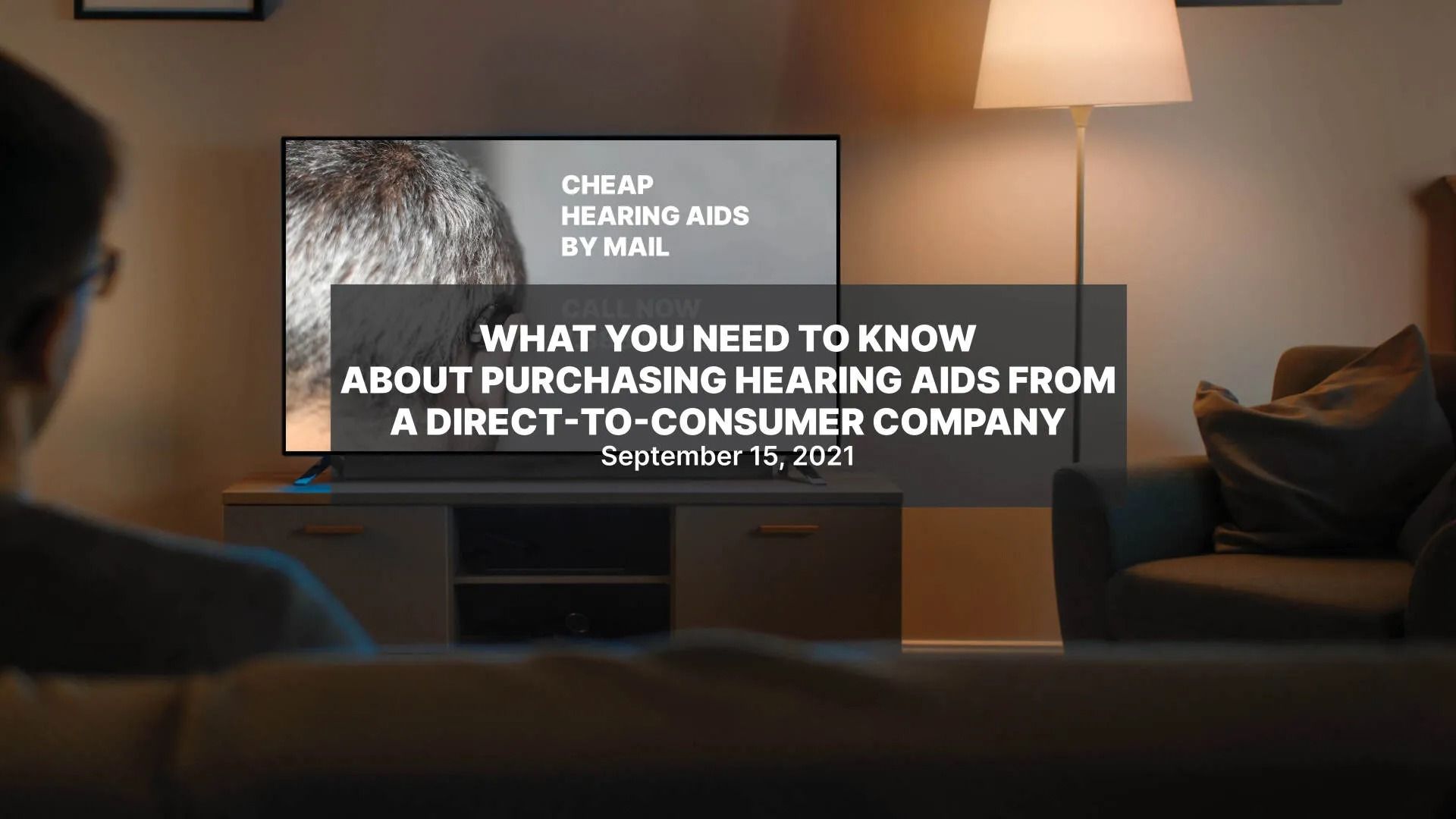
A man is sitting in front of a television in a living room.

Purchasing hearing aids without working with an audiologist—the hearing health care professional with the most education and training to treat hearing loss—has become increasingly more main­stream. Consumers can find a variety of items billed as hearing aids through direct-to-consumer (DTC) methods. They might be marketed to consumers through television, print and digital advertising as well as found by way of internet searches and at your local pharmacy or electronic store.


These devices are then mailed directly to a person’s home or sold over-the-counter. While this may seem convenient, is buy­ing through these sources the best option? The answer is no. Here’s why.


Don’t be lured in by the “lower prices” promise

These sources often advertise hearing aids for a price lower than what you would spend when working through an audiologist. However, the amount you actually pay the DTC entity will likely be much higher than advertised. Most companies that deal in mailed devices charge additional or hidden fees for supplies, programming services, programming equipment, repairs and/or warranties. These addi­tional services are essen­tial for being successful with hearing aids and are typically included in the cost of a hearing aid purchased from your local audiologist.


An accurate diagnostic test of your hearing loss is imperative for hearing aid success
Some DTC companies advertise “pre-set” devic­es and will “program” those devices without first obtaining a comprehensive hearing test by a licensed audiologist, instead having you take a hearing test online. Online hear­ing screenings cannot accurately diagnose hear­ing loss type or severity; they can only determine if a possible hearing loss is present. Your hearing loss is unique and cannot be completely generalized into a category of severity, as many DTC companies suggest.


Are they selling you an amplifier or a hearing aid?

If a DTC company attempts to classify your hearing loss based on your answers to a few questions or uses only one response from a hearing test to determine which hearing aid you need, you may actually be purchasing an amplifi­er that is being marketed as a hearing aid. Hearing aids are class II medical devices and MUST be pro­grammed specifically for you based on the results obtained during your comprehensive hear­ing evaluation. This is required for a precise and optimized fitting. If devic­es are not programmed in this manner, they will not provide benefit in difficult listening environments and overall sound quality will suffer. Obtaining a cur­rent hearing test prior to pursuing amplification is crucial to determining an appropriate treatment plan as well as a major factor in determining a person’s success with hearing aids. A new category of hearing devices that entered the market in 2022 is an “over-the-counter” hearing device.


In-person appointments with your audiologist are a key to hearing aid success

DTC companies often boast that their devices will be sent directly to you. Keep in mind that means you are on your own when it comes to figuring out your new hearing aids. Having your audiologist as a trusted profession­al who will walk you through the process of hearing aid use, care, and cleaning and having someone to turn to as you adjust to your new hearing aids is vital.


Imagine this scenario: You are having diffi­culty communicating with your loved ones, or you are feeling isolated from your friends. You find what you think is a solution through DTC, order the hearing aids or an amplifier, and get excited that you will finally be able to hear better! The devices arrive and you pull them out of the box, but you quickly find that you don’t know how to insert them, don’t know how to change the batteries or seat them in a charging station, don’t know what all the parts do, and find that they just don’t sound right. Then, while trying to figure out how everything works, you drop one of your hearing aids and it breaks! You quick­ly become frustrated and have no idea what to do. You call the online com­pany where you purchased the hearing aids, but you are put on hold. You want to talk to a person face-to-face, so you stop by your local audiologist’s office for help. You find out that only very minor repairs can be made, because your brand of hearing aid is considered a proprietary device (belonging only to the online retailer you purchased from). Since it is a proprietary device, the hearing aids can’t be adjusted or programmed in this office, even though you have already identi­fied numerous situations where they are not helping you communicate. You are told that you will need to send the hearing aids back to the DTC company for programming adjustments, which does not allow for real time feedback from the you when the adjustment is made. You may even be required to send your hearing aids in multiple times before your concern is addressed. Unfortunate­ly, each time you return the hearing aids to the company, you will likely be required to pay for ship­ping and will be without sound until your hearing aids are returned. The investment of time and money is ultimately much higher than you anticipated when you purchased these devices based on low price and the “convenience” of having them mailed to your home. This is just one example experienced by a person who came to Johnson Audiology for help, after purchasing a set of proprietary hearing aids online.


Beware of well-known hearing aid brands you find online

Occasionally, online consumers are able to find a hearing aid from one of the ”Big 6” hearing aid manufacturers (Oticon, Phonak, Resound, Siemens, Starkey, and Widex) that are supposedly dispensed by an audiol­ogists; however, purchase of these devices online can be very costly and is not recommended. The major manufacturers do not authorize the sale of their products online and are warning consumers not to purchase hearing aids in this manner. Many manu­facturers will void the war­ranties of any devices pur­chased online, ultimately adding additional costs to the consumer’s perceived “low price.” Some manu­facturers are even recalling hearing aids sold by these online companies and have requested that the hearing aids be returned once located.


Scheduling an appoint­ment with and investing in hearing aid technolo­gy through an audiologist ensures that you are well-informed regarding your hearing health care, that your treatment plan is tai­lored specifically to you, that you are offered the latest technology, and that you have a trusted hearing professional close to home who is support­ing you every step of the way. Plus, any poten­tial medical components to your hearing loss will be recognized by your audiologist and a treatment plan mapped. Your ears and sense of hearing are important. Don’t trust this vital area of your health to DTC companies that are retail-driven entities rather than health care professionals who really care about your hearing.

Recent Posts

Two people in a natural setting observe a blue bird through binoculars, with musical notes illustrating the bird's song.
By Jan Hollingsworth March 31, 2026
When Life Gets Quieter: The First Sounds Hearing Loss Takes High-frequency sounds play a powerful role in how we experience the world—yet they’re often the first to fade when hearing loss begins. These sounds include birdsong, children’s voices, and many women’s voices, all of which carry pitches that sit higher on the hearing spectrum. Because of this, even mild hearing loss can quietly chip away at some of life’s most meaningful and emotionally rich moments. For many people, the first sign of hearing loss isn’t silence—it’s subtle absence. The cheerful chirping of birds in the morning may seem less vibrant or disappear altogether. Conversations with children may start to sound muffled or unclear, especially when they speak quickly or softly. Women’s voices, which often rely more on higher frequencies, can become harder to distinguish, particularly in group settings or noisy environments. These changes can happen gradually, making them easy to overlook or dismiss as background noise or distraction. This type of hearing loss, often associated with aging or prolonged exposure to noise, affects the tiny hair cells in the inner ear that are responsible for detecting high-frequency sounds. Once these cells are damaged, they don’t regenerate—meaning those crisp, detailed sounds become increasingly difficult to hear without intervention. The impact goes beyond missing pleasant sounds; it can affect communication, relationships, and overall quality of life. Misunderstandings in conversation may become more frequent. Social situations can feel frustrating or isolating. And those small, joyful sensory experiences—like hearing a child laugh clearly or enjoying a quiet moment filled with birdsong—can slip away. The good news is that hearing technology today is more advanced than ever. Modern hearing aids are designed to specifically target and amplify high-frequency sounds, helping to restore clarity and bring those missing details back into everyday life. Early detection is key, which is why regular hearing evaluations are so important—especially if you’ve started to notice these subtle changes. Hearing loss doesn’t have to mean losing connection to the sounds that matter most. By recognizing the early signs and taking action, it’s possible to rediscover the richness of sound—including the simple, beautiful notes that make life feel full. Schedule Your Hearing Evaluation Today Don’t let hearing difficulties take life's most enriching sound from. you. A simple hearing test can provide valuable insight into your hearing health and help you get back some of the sounds you have been missing. Visit www.johnsonaudiology.com/schedule to make a hearing evaluation appointment and start hearing the birds again.
By Jan Hollingsworth March 12, 2026
Starkey Omega AI Is Now Available at Johnson Audiology There's a kind of exhaustion that comes with straining to hear — following along, nodding, guessing — and feeling like you missed most of it anyway. Better hearing technology doesn't just help you hear more. It helps you stop working so hard to listen. Starkey's newest platform, Omega AI, was built with exactly that in mind. And we're proud to now offer it at Johnson Audiology. Smarter Sound, Right When You Need It At the heart of Omega AI is DNN 360, the world's first deep neural network–powered directionality system. In real-world terms, that means voices stand out more clearly in the places that have always been the hardest: noisy restaurants, busy family events, crowded spaces. Starkey reports up to 28% better speech intelligibility and an 8 dB signal-to-noise improvement — without any sacrifice to battery life, which runs up to 51 hours. The AI doesn't stop there. A feature called TeleHear AI listens to your sound concerns and makes an instant adjustment with 93% accuracy right from the My Starkey app. And the built-in Gen AI Smart Assistant lets you ask questions, change programs, and set reminders using your voice, the same way you'd interact with a smart assistant on your phone. For patients who want more control between appointments, it's a meaningful shift in how hearing care works day to day. Built to Keep Up with Your Day Omega AI is waterproof with a coating tested to last 10 times longer than previous generations, so daily life; rain, sweat, an active schedule, isn't something you need to work around. New LED indicator lights let you confirm power and Bluetooth connection immediately, and in an industry first, those same lights double as a find-my-hearing-aid tool through the My Starkey app. More Than Just Hearing Omega AI also brings two health-focused tools to the My Starkey app. Balance Builder offers guided at-home exercises to support stability, especially valuable for patients managing fall risk. And an automatic respiratory rate monitor quietly tracks breathing in the background throughout the day, helping patients and their care teams stay a step ahead. Omega AI also supports Auracast™ connectivity, which lets you tune in to broadcast audio in public spaces including airports, theaters, places of worship, etc. directly through your hearing aids with a simple tap. It's the kind of feature that quietly makes a big difference in the moments that matter most. It's a reflection of something we believe deeply at Johnson Audiology: hearing care is health care. Let's Find the Right Fit for You If you're wondering whether Omega AI could be right for your hearing and your lifestyle, we'd love to help. Schedule a comprehensive hearing evaluation at any of our locations across Tennessee and North Georgia, and let our team guide you from there. Because better hearing isn't just about sound, it's about everything sound connects you to.
By Jan Hollingsworth March 12, 2026
Oticon Zeal™ Is Now Available at Johnson Audiology Johnson Audiology is pleased to now offer Oticon Zeal, a breakthrough in hearing technology that delivers premium sound performance in an exceptionally compact and discreet design. Oticon Zeal represents a significant advancement in both engineering and sound processing. By combining durability, artificial intelligence-driven sound clarity, rechargeability, and seamless connectivity, Zeal offers patients a comprehensive hearing solution — without compromise. A Breakthrough in Design: Innovative Encapsulation Technology One of the defining innovations behind Oticon Zeal is its advanced encapsulation technology. This method encloses the body of the device in a single, solid structure, creating a hearing aid that is both robust and moisture resistant (IP68-rated). This innovative design allows Zeal to be: More protected against everyday wear and environmental exposure More compact and discreet More durable without sacrificing performance Patients no longer have to choose between premium sound quality and a small, cosmetically appealing device. Zeal is engineered to provide both. Advanced AI Sound Processing — Always On Oticon Zeal is powered by Oticon’s most advanced AI-driven sound processing technology to date. This “always-on” system continuously analyzes the listening environment, helping the brain access clearer, more balanced sound in real time. The result is improved speech understanding, even in complex listening environments. Zeal provides up to 6 dB signal-to-noise ratio (SNR) improvement and has been tested on more than 1,500 ears, demonstrating measurable performance benefits. Rather than simply amplifying sound, Zeal works intelligently to support how the brain naturally interprets speech and environmental cues. Always-On Connectivity Modern hearing technology must integrate seamlessly into daily life. Oticon Zeal introduces uncompromising connectivity through a newly designed skin-coupling antenna and optimized tap control for discreet and intuitive use. Patients can enjoy seamless connectivity with: Smartphones Tablets Personal computers Televisions Zeal also supports hands-free calling through Bluetooth® LE Audio and is compatible with Auracast™ broadcast audio in public spaces. This expanded connectivity allows patients to stay engaged at home, at work, and in community settings with greater ease and clarity. Reliable Rechargeability As a true all-in-one hearing aid, Oticon Zeal features rechargeable lithium-ion battery technology. Users can: Charge overnight for a full day of power* Gain up to four hours of use with a quick 15-minute charge This flexibility provides peace of mind, especially for active individuals who are frequently on the go. Patients no longer need to manage disposable batteries or worry about running out of power during important conversations or events. Flexible, Personalized Fitting at Johnson Audiology Oticon Zeal is designed to support a personalized fitting experience. Its dome-to-mold flexibility allows clinicians to begin new users with a dome and transition to a micromold if needed to meet individual anatomical or acoustic requirements. At Johnson Audiology, we use comprehensive diagnostic testing and individualized programming to ensure each device is tailored to your specific hearing needs and lifestyle goals. Zeal enables us to offer a premium, discreet solution while maintaining the personalized care our patients expect. Schedule a Consultation If you are interested in learning whether Oticon Zeal is right for you, we invite you to schedule a comprehensive hearing evaluation at one of our locations in Tennessee or North Georgia. Our team is here to help you explore your options and find the hearing solution that best supports your daily life.
Two people in a natural setting observe a blue bird through binoculars, with musical notes illustrating the bird's song.
By Jan Hollingsworth March 31, 2026
When Life Gets Quieter: The First Sounds Hearing Loss Takes High-frequency sounds play a powerful role in how we experience the world—yet they’re often the first to fade when hearing loss begins. These sounds include birdsong, children’s voices, and many women’s voices, all of which carry pitches that sit higher on the hearing spectrum. Because of this, even mild hearing loss can quietly chip away at some of life’s most meaningful and emotionally rich moments. For many people, the first sign of hearing loss isn’t silence—it’s subtle absence. The cheerful chirping of birds in the morning may seem less vibrant or disappear altogether. Conversations with children may start to sound muffled or unclear, especially when they speak quickly or softly. Women’s voices, which often rely more on higher frequencies, can become harder to distinguish, particularly in group settings or noisy environments. These changes can happen gradually, making them easy to overlook or dismiss as background noise or distraction. This type of hearing loss, often associated with aging or prolonged exposure to noise, affects the tiny hair cells in the inner ear that are responsible for detecting high-frequency sounds. Once these cells are damaged, they don’t regenerate—meaning those crisp, detailed sounds become increasingly difficult to hear without intervention. The impact goes beyond missing pleasant sounds; it can affect communication, relationships, and overall quality of life. Misunderstandings in conversation may become more frequent. Social situations can feel frustrating or isolating. And those small, joyful sensory experiences—like hearing a child laugh clearly or enjoying a quiet moment filled with birdsong—can slip away. The good news is that hearing technology today is more advanced than ever. Modern hearing aids are designed to specifically target and amplify high-frequency sounds, helping to restore clarity and bring those missing details back into everyday life. Early detection is key, which is why regular hearing evaluations are so important—especially if you’ve started to notice these subtle changes. Hearing loss doesn’t have to mean losing connection to the sounds that matter most. By recognizing the early signs and taking action, it’s possible to rediscover the richness of sound—including the simple, beautiful notes that make life feel full. Schedule Your Hearing Evaluation Today Don’t let hearing difficulties take life's most enriching sound from. you. A simple hearing test can provide valuable insight into your hearing health and help you get back some of the sounds you have been missing. Visit www.johnsonaudiology.com/schedule to make a hearing evaluation appointment and start hearing the birds again.
By Jan Hollingsworth March 12, 2026
Starkey Omega AI Is Now Available at Johnson Audiology There's a kind of exhaustion that comes with straining to hear — following along, nodding, guessing — and feeling like you missed most of it anyway. Better hearing technology doesn't just help you hear more. It helps you stop working so hard to listen. Starkey's newest platform, Omega AI, was built with exactly that in mind. And we're proud to now offer it at Johnson Audiology. Smarter Sound, Right When You Need It At the heart of Omega AI is DNN 360, the world's first deep neural network–powered directionality system. In real-world terms, that means voices stand out more clearly in the places that have always been the hardest: noisy restaurants, busy family events, crowded spaces. Starkey reports up to 28% better speech intelligibility and an 8 dB signal-to-noise improvement — without any sacrifice to battery life, which runs up to 51 hours. The AI doesn't stop there. A feature called TeleHear AI listens to your sound concerns and makes an instant adjustment with 93% accuracy right from the My Starkey app. And the built-in Gen AI Smart Assistant lets you ask questions, change programs, and set reminders using your voice, the same way you'd interact with a smart assistant on your phone. For patients who want more control between appointments, it's a meaningful shift in how hearing care works day to day. Built to Keep Up with Your Day Omega AI is waterproof with a coating tested to last 10 times longer than previous generations, so daily life; rain, sweat, an active schedule, isn't something you need to work around. New LED indicator lights let you confirm power and Bluetooth connection immediately, and in an industry first, those same lights double as a find-my-hearing-aid tool through the My Starkey app. More Than Just Hearing Omega AI also brings two health-focused tools to the My Starkey app. Balance Builder offers guided at-home exercises to support stability, especially valuable for patients managing fall risk. And an automatic respiratory rate monitor quietly tracks breathing in the background throughout the day, helping patients and their care teams stay a step ahead. Omega AI also supports Auracast™ connectivity, which lets you tune in to broadcast audio in public spaces including airports, theaters, places of worship, etc. directly through your hearing aids with a simple tap. It's the kind of feature that quietly makes a big difference in the moments that matter most. It's a reflection of something we believe deeply at Johnson Audiology: hearing care is health care. Let's Find the Right Fit for You If you're wondering whether Omega AI could be right for your hearing and your lifestyle, we'd love to help. Schedule a comprehensive hearing evaluation at any of our locations across Tennessee and North Georgia, and let our team guide you from there. Because better hearing isn't just about sound, it's about everything sound connects you to.