
Untreated hearing loss is changing your brain

May 16, 2024
An advertisement for untreated hearing loss is changing your brain

Research reveals that hearing loss actually rewires your neural pathways


Your Amazing Brain

Your brain is an amazing organ! This wrinkly, reddish-pink mass weighs about the same as your two-slice toaster, tipping the scales at about three pounds. Acting as a master control center, your brain enables every thought, breath, eye blink, heartbeat, movement—everything—that happens in your body. Rivaling the world’s most powerful supercomputer, your brain can download, process, and react in milliseconds to the tidal wave of information coming from your eyes, skin, nose, tongue, and ears.


Neuroplasticity and Your Sense of Hearing

Researchers have discovered that the human nervous system—made up of the brain, spinal cord, and a complex network of nerves—has incredible capacity to modify itself, both in function and physical structure. This is called neural plasticity. Dr. Megan Johnson, audiologist and owner of Johnson Audiology explains, “Neural plasticity is going gangbusters in a child’s brain as the child develops and matures into adulthood. Based on years of brain research, we also know that the adult brain is far from being fixed. It, too, changes and adapts when you learn new information or skills or as a response to stress, hormonal fluctuations, drug interactions, injury, and much more.”


Dr. Johnson also relates that “your brain displays neuroplasticity when you experience hearing loss.” By measuring brain waves using an electroencephalograph, or EEG, scientists have studied how the brain of a person with hearing loss functions compared to a person with normal hearing. The results are both fascinating and sobering as studies reveal that, in those with hearing loss, the portion of the brain devoted to hearing becomes reorganized. This can be true even with early-stage, mild hearing loss, and the process happens quickly, often in months rather than years.


The Hearing Center of Your Brain and Beyond

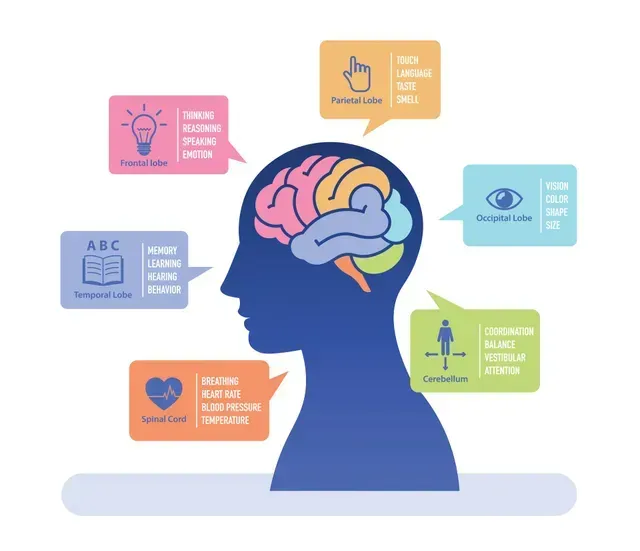
What is actually happening when this takes place? Your brain has a right and a left hemisphere and six major lobes. Think of your frontal lobe as your brain’s boss, where executive functions like decision making, emotion and impulse control, and planning occur. Your temporal lobe, which contains the auditory cortex, is doing the heavy lifting when it comes to interpreting sounds and assigning those sounds meaning. The temporal lobe processes speech and language, and it is where initial learning of new information takes place, which is the first step for logging that information into memory.


Dr. Johnson goes on to relate, “When the delicate infrastructure of your ear has become damaged through noise exposure, infection, etc. leading to hearing loss, your auditory cortex cries out to your frontal lobe, saying ‘Help! Help! I’m not receiving any sound to process, so I feel lost.’ The frontal lobe ‘boss’ jumps to attention, and your occipital lobe, responsible for processing vision and touch, takes over the areas in which hearing is normally processed. In other words, your other senses seek to compensate for the deficit due to the loss of your sense of hearing.”


Amazing, right? So, where’s the rub? Picture a car assembly line; each worker has an assigned task. One day, the worker who installs the windshields is absent, and the worker who attaches the rearview mirrors is assigned double duty, and a duty that was not part of job training. It is easy to see how the worker left juggling both jobs is compromised, and a car might slip through minus a rear view mirror.


Similarly, the areas of your brain that are being taxed to make up for a lack of hearing are overloaded and less able to do their assigned responsibilities. “This explains why so many of my patients with hearing loss relate feeling exhausted and frustrated after a big family gathering—where multiple talkers and sounds must be interpreted—rather than happy and invigorated by the experience. We call this listening fatigue,” states Dr. Johnson.


Additionally, when left untreated long enough, researchers point to the brain’s reorganization due to hearing loss as a significant correlation with dementia.


Hearing Technology and Your Brain

“But here's the great news!” Dr. Johnson says. When a person is fit with hearing aids or a cochlear implant and sound is restored, the brain has the ability to adjust back—partially or completely—to proper function. How swiftly that happens often depends on how long the hearing loss went untreated and is why she encourages patients to treat hearing loss sooner rather than later. “Here is what I tell patients who are downplaying the importance of hearing: If you won’t treat your hearing loss for the sake of your ears, do it for your brain!”

A silhouette of a person 's head with a brain and speech bubbles around it.

Recent Posts

woman listening at work
By Jan Hollingsworth February 23, 2026
Hearing loss does not just change how you hear the world—it can quietly change how you feel about yourself, eroding your confidence by degrees. Many people assume self-assurance arises from a person’s unique personality or maturity, but untreated hearing loss often plays a bigger role than we realize. If you have ever felt more hesitant, withdrawn, or unsure in social situations, your hearing may be part of the story. Here are five indicators that hearing loss may be affecting your confidence. 1. You Avoid Social Situations You Used to Enjoy If a meal out with friends, or an invitation to a family birthday gathering, or a group meeting at work now feel exhausting or stressful, you may find your declining invitations. When conversations become hard to follow, it’s natural to fear missing something important or responding incorrectly. Over time, avoidance can chip away at confidence and reinforce the feeling that social situations are “not for you anymore,” even though the real issue is hearing clarity—not ability or personality. 2. You Second-Guess Yourself in Conversations Do you often nod along, laugh when others laugh, or give vague responses because you’re not entirely sure what was said? This constant guessing can make you feel insecure and anxious. When you’re worried about misunderstanding others, it’s hard to speak up confidently or express your thoughts freely. 3. You Feel Fatigued After Talking or Listening Straining to hear requires intense concentration. By the end of the day, this listening fatigue can leave you mentally drained and less self-assured. When you are tired, confidence naturally dips—you may feel less articulate, less patient, and less willing to engage. This can lead to a cycle where you participate less, reinforcing feelings of self-doubt. 4. You Have Stopped Speaking Up at Work In professional settings, confidence is closely tied to communication. If you’ve noticed yourself staying quiet in meetings, avoiding phone calls, or hesitating to share ideas, hearing challenges could be the reason. Fear of mishearing instructions or responding incorrectly can hold you back, even when you’re highly capable and knowledgeable. In fact, hearing loss has even been linked to a person’s earning potential and ability to advance professionally. 5. You Feel Isolated or “Left Out” One of the most subtle but impactful effects of hearing loss is emotional distance. When conversations move quickly or occur in noisy environments, it is easy to feel disconnected. Over time, this can lead to loneliness and the belief that you don’t belong, which directly undermines confidence and self-esteem. As time passes and hearing loss goes unaddressed, your brain may rewire itself both physically and functionally as a way of compensating, which can potentially affect your cognition and increase your risk for dementia.  The Good News: You Can Re-harness Your Confidence Hearing loss doesn’t have to define how you feel about yourself. With proper evaluation, treatment options, and support, many people report feeling more engaged, capable, and confident again. Addressing hearing loss is not just about sound—it’s about reconnecting with conversations, relationships, and tapping into the most confident version of yourself.
Woman holding phone, showing purple urn with floral design to a man in a black shirt. They stand near a window.
December 10, 2025
A touching story of how a donated pair of hearing aids connected Diane, her late sister Denise, and Tyler through the Johnson Audiology Hearing Foundation.
a
August 7, 2025
Explore your hearing care options and learn why audiologists at Johnson Audiology are your best choice for expert, personalized hearing health.
woman listening at work
By Jan Hollingsworth February 23, 2026
Hearing loss does not just change how you hear the world—it can quietly change how you feel about yourself, eroding your confidence by degrees. Many people assume self-assurance arises from a person’s unique personality or maturity, but untreated hearing loss often plays a bigger role than we realize. If you have ever felt more hesitant, withdrawn, or unsure in social situations, your hearing may be part of the story. Here are five indicators that hearing loss may be affecting your confidence. 1. You Avoid Social Situations You Used to Enjoy If a meal out with friends, or an invitation to a family birthday gathering, or a group meeting at work now feel exhausting or stressful, you may find your declining invitations. When conversations become hard to follow, it’s natural to fear missing something important or responding incorrectly. Over time, avoidance can chip away at confidence and reinforce the feeling that social situations are “not for you anymore,” even though the real issue is hearing clarity—not ability or personality. 2. You Second-Guess Yourself in Conversations Do you often nod along, laugh when others laugh, or give vague responses because you’re not entirely sure what was said? This constant guessing can make you feel insecure and anxious. When you’re worried about misunderstanding others, it’s hard to speak up confidently or express your thoughts freely. 3. You Feel Fatigued After Talking or Listening Straining to hear requires intense concentration. By the end of the day, this listening fatigue can leave you mentally drained and less self-assured. When you are tired, confidence naturally dips—you may feel less articulate, less patient, and less willing to engage. This can lead to a cycle where you participate less, reinforcing feelings of self-doubt. 4. You Have Stopped Speaking Up at Work In professional settings, confidence is closely tied to communication. If you’ve noticed yourself staying quiet in meetings, avoiding phone calls, or hesitating to share ideas, hearing challenges could be the reason. Fear of mishearing instructions or responding incorrectly can hold you back, even when you’re highly capable and knowledgeable. In fact, hearing loss has even been linked to a person’s earning potential and ability to advance professionally. 5. You Feel Isolated or “Left Out” One of the most subtle but impactful effects of hearing loss is emotional distance. When conversations move quickly or occur in noisy environments, it is easy to feel disconnected. Over time, this can lead to loneliness and the belief that you don’t belong, which directly undermines confidence and self-esteem. As time passes and hearing loss goes unaddressed, your brain may rewire itself both physically and functionally as a way of compensating, which can potentially affect your cognition and increase your risk for dementia.  The Good News: You Can Re-harness Your Confidence Hearing loss doesn’t have to define how you feel about yourself. With proper evaluation, treatment options, and support, many people report feeling more engaged, capable, and confident again. Addressing hearing loss is not just about sound—it’s about reconnecting with conversations, relationships, and tapping into the most confident version of yourself.
Woman holding phone, showing purple urn with floral design to a man in a black shirt. They stand near a window.
December 10, 2025
A touching story of how a donated pair of hearing aids connected Diane, her late sister Denise, and Tyler through the Johnson Audiology Hearing Foundation.